


Bendy and the Ink Machine
Joey Drew Studios
I first approached Bendy and the Ink Machine as a short horror adventure, but it quickly became clear that its strongest quality is how well it turns a strange cartoon world into a place I wanted to investigate. The setting is an old animation studio filled with ink, abandoned machinery, distorted characters, and clues that gradually make the story more unsettling. It is not simply a game about running away from monsters. It asks me to look closely, remember details, solve environmental puzzles, and decide when exploring one more room is worth the risk.
That makes it a particularly interesting choice for a shared household device. One person can play while another watches and helps spot symbols, objects, or possible routes. At the same time, the horror atmosphere means it is not something I would casually hand to every child in the home. The Teen content rating matters here, especially because the game depends on tension, threatening imagery, and sudden danger rather than gentle cartoon comedy.
A horror adventure that works well as a shared mystery
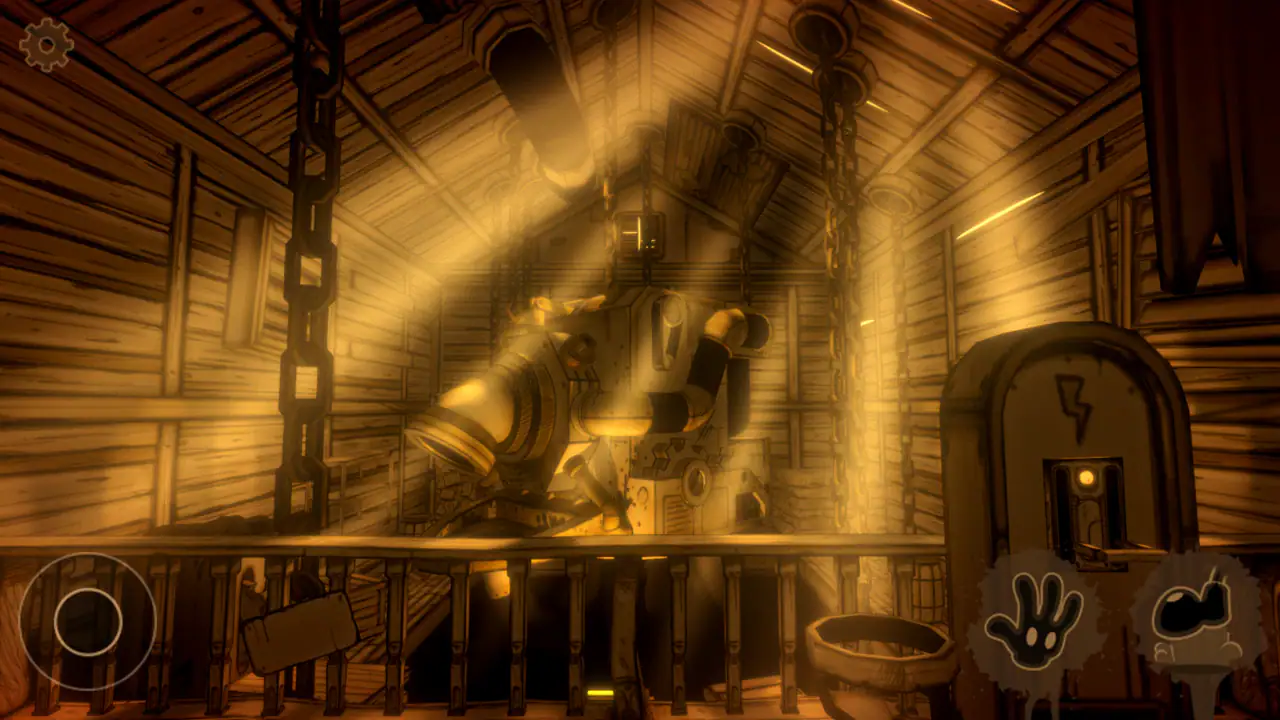
The central appeal is the contrast between the cheerful visual language of classic animation and the decaying studio surrounding it. The black-and-yellow presentation gives everything a recognizable identity, yet the familiar style becomes uncomfortable when machines start moving, corridors feel abandoned, and ink seems to be part of the building itself. I enjoyed that the game does not need constant action to maintain pressure. A quiet hallway can be more effective than a direct confrontation because I am left wondering what the next sound means.
In a household setting, this creates a useful shared-play rhythm. I can hold the device and explore while someone else follows the story, suggests where to look, or remembers a clue from an earlier area. It feels closer to solving a mystery together than taking turns in a traditional action game. A younger teenager might enjoy identifying visual patterns, while an older player may be better at managing movement and reacting during tense encounters.
The game is still designed around one player’s progress, so I would not treat it as a proper multiplayer activity. There is no reason to expect two people to control the same scene together. Instead, the shared value comes from discussion and observation. That distinction is important if you are choosing something for siblings who specifically want cooperative controls. For that purpose, a dedicated cooperative game would be a better match.
Related News






My most enjoyable sessions happened when I resisted the urge to rush. The studio rewards attention: a room may contain a visual hint, a machine that needs to be understood, or a path that only makes sense after I have examined the surrounding area. I found that playing with another person nearby sometimes improved the experience because we noticed different details. One of us would focus on the story while the other kept track of suspicious objects or possible objectives.
What the setup means on a household device
The game is available for Android and belongs to the adventure category, but its tone makes the initial decision more important than the installation itself. It costs $4.99, so I see it as a deliberate purchase rather than something to install casually and forget. The developer is Joey Drew Studios, and the game was released on Dec 20, 2018. Its current version is 2.1.0, and it requires Android 6.0 or later.
That operating-system requirement is relatively broad, but compatibility alone does not tell me how comfortable a particular phone or tablet will feel during play. On a shared device, I would check that the screen is large enough for the controls and that the device is not being used for an urgent task before starting. Horror games benefit from concentration. Notifications, low battery, or someone needing the device halfway through a tense section can interrupt the atmosphere more than they would in a casual puzzle game.
Gallery
I also recommend agreeing on who is buying and playing before downloading it. A family may share a tablet, but ownership of the purchase and responsibility for progress can become awkward if several people assume the game belongs to them. Since the experience is story-driven, different players may want to discover events in their own order. A simple household rule—one person continues the main save while others watch, or players take turns only at agreed stopping points—can prevent accidental spoilers and arguments.
The game does not need to be treated like a permanent family activity. It works better as a focused evening experience, perhaps with one player completing a section while another person watches. I would avoid starting it when a child is expected to go straight to sleep, because the visual design and suspense can linger after the device is put away. That is not a technical problem; it is a practical consequence of choosing horror for a shared screen.
How I would coordinate turns and discoveries
Because the game combines exploration, puzzles, and danger, different players can contribute in different ways. The person holding the device handles movement and encounters, while the person watching can keep an eye on environmental clues. This is especially useful when the scene contains several objects that look decorative but may be relevant to the next task. Talking aloud turns the game into a cooperative reasoning exercise without pretending that it has built-in co-op.
I found it helpful to stop after reaching a clear change in the story rather than passing the device during a chase or puzzle attempt. Handing over control in the middle of a stressful sequence can make the next player feel lost and may lead to unnecessary mistakes. A better routine is to finish an objective, explain what has just happened, and then let the next person decide whether to explore or continue.
For households with more than one interested player, I would keep a simple verbal record of progress: the last area visited, the current objective, and any clue that has not yet been understood. This is not a feature of the game, just a practical way to protect the story from confusion. It also lets a younger player participate even when they are not the one playing. They can make predictions, identify recurring images, or ask why a particular room feels important.
There is a trade-off here. Watching someone else play can make the horror less intense because the viewer is not responsible for movement, but it can also make puzzles more enjoyable. If one person dislikes jump scares or pressure, taking the observer role may be the right compromise. If another person wants complete discovery, they should have a separate turn without hints from the group.
Age, trust, and the tone of the content
The Teen rating is not a detail I would ignore simply because the characters look like old cartoons. The art style is deliberately misleading in the best creative sense: it uses familiar animation shapes while placing them in a threatening, damaged environment. The result can feel more disturbing than a plainly realistic horror game because the contrast is so strong. I would show the game’s visual style to a younger player first and discuss whether they are comfortable with suspense and frightening encounters.
For a teenager who enjoys mystery, atmosphere, and light action, this can be a good shared choice. For a child who is sensitive to dark spaces, sudden threats, or unsettling character designs, I would choose something gentler. The important point is not whether the game looks colorful at first glance; it is whether the player can handle the tension that develops underneath that style.
In my experience, trust also matters because the game encourages curiosity. A player may want to inspect every corner, while another may prefer to move quickly through dangerous areas. I would let the person playing decide when to pause rather than pressuring them to continue because everyone else wants to see what happens. That makes the experience more comfortable and preserves the game’s suspense instead of turning it into a challenge imposed by the audience.
The story is another reason to think about who is watching. I enjoyed piecing together the studio’s history through the environment, but younger players may focus mainly on the frightening moments. If the game is being shared with a teenager and an adult, a short conversation afterward can help separate fictional horror from real danger and give the player space to explain what they found disturbing or interesting.
Where it stands beside other adventure and horror games
Compared with a straightforward action game, this one asks for more patience. The satisfaction often comes from understanding a location rather than defeating an opponent immediately. Compared with a pure puzzle adventure, it adds pressure through its horror presentation and moments of danger. That combination is its identity, but it also means it will not suit someone who wants either relaxed problem-solving or constant fast combat.
I would choose it over a conventional cartoon adventure when atmosphere is the priority. The visual style is not merely decoration; it shapes how I interpret every room. On the other hand, I would choose a calmer exploration game for a family that wants open-ended discovery without fear. I would also choose a purpose-built multiplayer title when the main goal is simultaneous participation rather than one person playing while others advise.
The game’s strongest advantage over many ordinary mobile adventures is that it feels designed around a distinct world. The studio setting gives the puzzles and threats a shared context, so exploration does not feel like a sequence of unrelated levels. Its weakness is that the same focused atmosphere can make it less flexible for casual household use. It is not the kind of game I would open for five minutes while waiting in a queue and expect to get the best from it.
The price also affects the comparison. At $4.99, I would expect a more complete, focused experience than a free game built around interruptions, but I would still buy it for the specific horror-adventure style rather than as an all-purpose family game. If your household wants variety for many ages, a broader collection may offer better value. If you specifically want a memorable ink-soaked mystery, the purchase is easier to justify.
Small decisions that make the experience better
My first practical tip is to use headphones only when the player is comfortable with the horror level and is in a suitable environment. Sound contributes heavily to suspense, but headphones also make the experience more isolating. For a shared session, keeping audio audible to the room may be better because everyone can follow the mood and discuss what they hear.
My second tip is not to treat every locked or unfamiliar area as an immediate problem. The studio is built to make me curious, and trying to force progress without understanding the surrounding clues can turn exploration into frustration. I had better results by revisiting nearby rooms, examining machines, and paying attention to visual relationships before assuming I had missed a complicated solution.
Third, I would avoid letting a group of viewers shout instructions constantly. The game is more enjoyable when the player has time to interpret the environment. A useful compromise is to let observers offer suggestions only after the player asks or after a reasonable attempt. That keeps the shared session collaborative without removing the satisfaction of solving a puzzle independently.
Fourth, plan a stopping point before beginning a session. Horror games can encourage “one more room,” especially when a story reveal seems close, but a household device may be needed by someone else. Ending after a completed objective is less disruptive than stopping during a chase. It also makes it easier for the next player to understand where the previous session ended.
Finally, if several people want to play, decide whether the group values discovery or efficiency. A first run with no hints is best for the person who cares about the story. A later shared run can be more relaxed, with viewers helping identify clues and routes. Mixing those goals in the same session can disappoint both the player who wants to solve everything and the person who simply wants to see the story advance.
Who should play it, and who should skip it
I recommend it to players who like atmospheric adventure games, environmental puzzles, and horror that builds through setting as much as through direct attacks. It is especially suitable for a teenager or adult who enjoys discussing theories and examining unusual details. It also works well for a parent, sibling, or friend who wants to participate by watching and reasoning without needing a second controller.
I would skip it for very young children, players who strongly dislike suspense, and households looking for a completely relaxed game to share across a wide age range. I would also skip it if your main requirement is online play, local co-op, or quick matches. This is a focused single-player adventure, and its value depends on accepting that structure.
The audience response gives some useful context: it holds a 4.5 average from around 18,000 ratings, with more than 3,000 written reviews and over 100,000 installs. Those figures suggest that the game has found a substantial mobile audience, but they should not replace a personal judgment about horror tolerance. A popular scary game can still be the wrong choice for one particular household.
My household verdict
I came away impressed by how confidently the game commits to its unusual setting. The ink-covered studio, old-fashioned animation look, and investigative pacing give it a personality that ordinary mobile adventures often lack. I also appreciate that it can become a conversation game in a shared room: one person explores, another notices clues, and everyone reacts to the story.
Its limitations are just as clear. It is not a universal family game, not a substitute for cooperative play, and not ideal for a distracted five-minute session. The Teen rating should guide the household decision, and the person playing should be comfortable with unsettling imagery and sustained suspense. Shared use works best when turns, spoilers, and stopping points are agreed in advance.
For me, the purchase makes sense when the goal is a distinctive horror adventure that can be experienced alone or discussed with someone nearby. If that sounds like your household, Bendy and the Ink Machine offers a memorable way to turn a single-player game into a shared mystery. If you need gentle all-ages entertainment or simultaneous teamwork, I would look elsewhere. Its best audience is clear, and within that audience, it is an atmospheric and worthwhile choice.
FAQs for Bendy and the Ink Machine
What is Bendy and the Ink Machine about?
Bendy and the Ink Machine is a first-person horror adventure set in an abandoned animation studio. You explore Joey Drew Studios, solve environmental puzzles, collect clues, and uncover the disturbing history behind its cartoon creations. The game combines exploration, story-driven mystery, stealth, and occasional combat, with a distinctive 1930s cartoon art style that creates an unsettling atmosphere.
Is Bendy and the Ink Machine suitable for children?
Although the game uses a cartoon-inspired visual design, Bendy and the Ink Machine is primarily a horror title and may not be suitable for young children. It includes frightening creatures, tense chase sequences, dark themes, disturbing imagery, and occasional violence. Parents should check the official age rating and consider a child’s sensitivity to suspense, monsters, and horror before allowing access.
Does the mobile version include the complete game?
The mobile edition is designed to provide the main Bendy and the Ink Machine experience in a portable format, including its chapter-based story and exploration gameplay. However, availability, chapter access, controls, performance, and included content can depend on the specific release and device. Before downloading, check the current store description to confirm what is included in your region.
Can Bendy and the Ink Machine be played offline?
After the game has been downloaded and installed, much of the single-player campaign can generally be played without a continuous internet connection. An internet connection may still be required for the initial download, account or store verification, updates, or restoring purchases, depending on your platform. It is advisable to launch the game once online before travelling or playing offline.
What devices are recommended for playing the game on mobile?
Bendy and the Ink Machine contains detailed environments, animated enemies, lighting effects, and several demanding story sequences, so performance can vary between phones and tablets. A relatively recent device with sufficient free storage and updated operating software should provide a smoother experience. Older or entry-level hardware may experience longer loading times, reduced performance, or compatibility limitations.
Pros
- Distinctive 1930s cartoon art style creates a memorable atmosphere.
- Exploration rewards curiosity with hidden notes
- rooms
- and story details.
- Sound design and music build tension effectively throughout the chapters.
- Puzzles offer variety beyond simple item collection and combat.
- The episodic structure gradually reveals an intriguing mystery.
Cons
- Some objectives are vague
- making progression feel confusing at times.
- Combat can feel clumsy
- especially during encounters with multiple enemies.
- Backtracking through familiar areas may become repetitive.
- Certain scares rely more on sudden appearances than sustained tension.
- The mobile version may require substantial storage and battery power.


